
The Best MaxRewards Alternative in 2026 (I Built It)
An honest MaxRewards vs. CardStack comparison from someone who used both.
 American Express® Gold Card


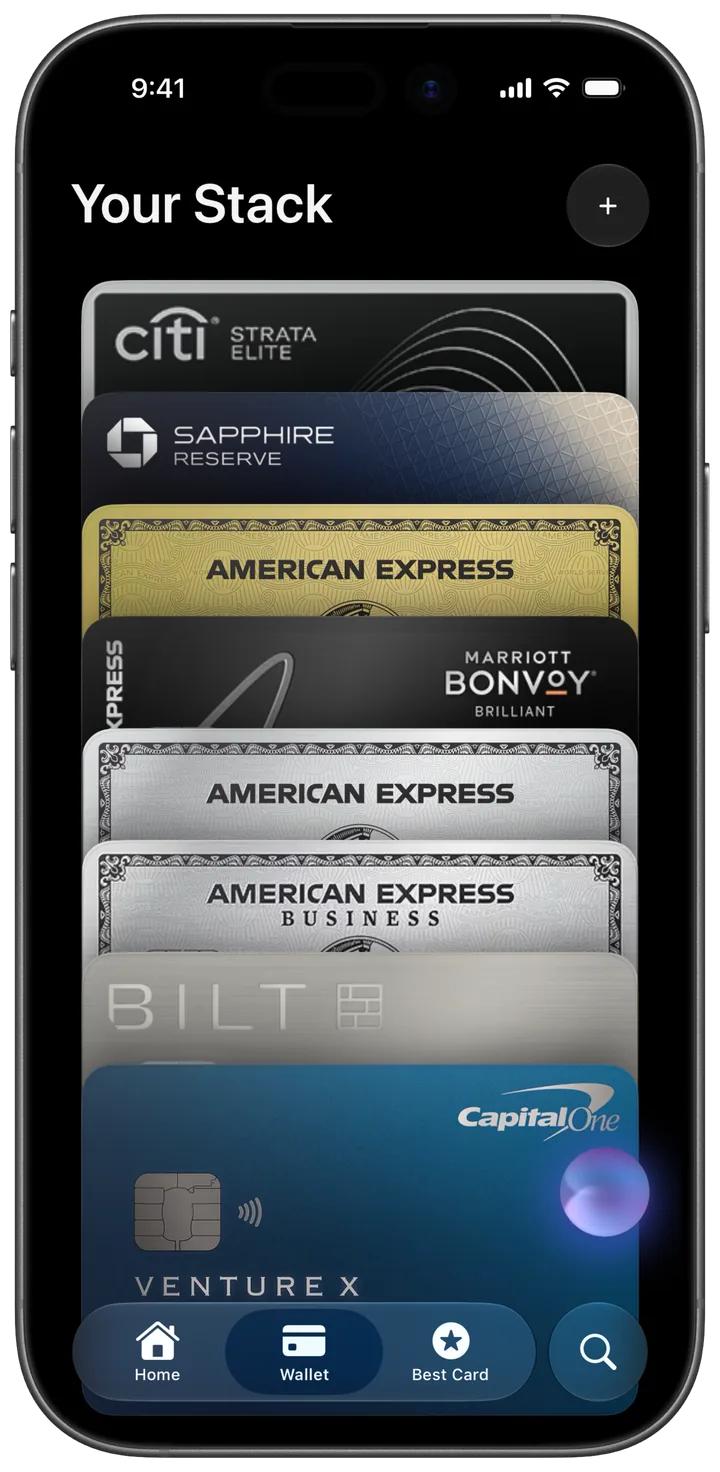
I’m Adam, CardStack founder, and I carry 12+ credit cards including Amex Platinum, Gold, Chase Sapphire Reserve, Bilt Palladium, Venture X, and a bunch more.
For years, I was paying over $1,200 in annual fees and capturing maybe half the value I was entitled to. I’d miss the $200 airline credit on my Platinum because I forgot it resets in January. I’d use my Bilt card at the grocery store instead of my Gold. That’s 1x instead of 4x on $800/month. I once paid a $695 annual fee on a card that gave me back $400 in credits. Not great math.
I tried MaxRewards. Tried a Google Sheet I updated for about two weeks before abandoning it. Neither solved the actual problem: I didn’t need another dashboard to check. I needed something that did the work.
So I built CardStack.
What MaxRewards Actually Does
I want to be fair here because MaxRewards does some things well.
Their best feature is offer auto-activation. You connect your Amex, Chase, Bank of America, Citi, and Discover accounts and MaxRewards activates available offers across all of them automatically. They also auto-activate rotating bonus categories on cards like the Chase Freedom Flex. If you have offers spread across five different issuer apps and don’t want to manually scroll through each one, that is real value.
The free Bronze tier gives you credit card bills, balances, and credit scores. Gold ($9+/month) adds a Benefits Tracker, sign-up bonus tracking, and retention offer tracking. Platinum ($20+/month) adds receipt matching and business spend separation.
They also have a Chrome extension (still in beta) and support 1,000+ cards.
Where MaxRewards Didn’t Work For Me
MaxRewards was built for offers. The benefits tracking came later, and it feels like it. The Gold tier has a Benefits Tracker, so the feature exists. But for someone with premium cards where the real money is in statement credits, it wasn’t enough.
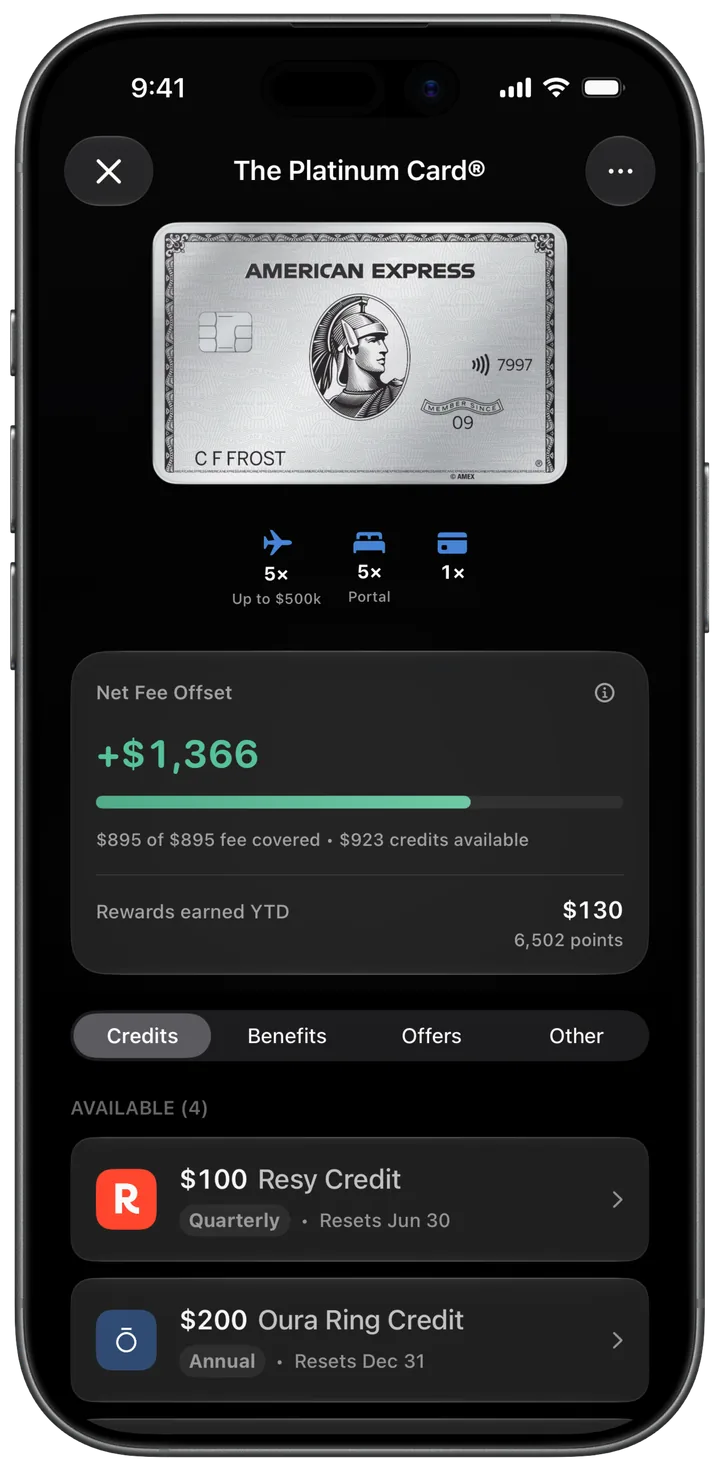
Take the Amex Platinum. It has approximately $2,994 in listed annual statement credits before the conditional Airbnb Experiences benefit: airline fee credit, Uber cash, digital entertainment, Lodging Credit, Equinox, Walmart+, and more.
The $600 Lodging Credit now includes eligible prepaid Airbnb Luxe bookings in the same shared $300-per-half allowance as FHR and The Hotel Collection. A qualifying prepaid Luxe booking and eligibility confirmation can unlock up to $250 for eligible Airbnb Experiences, bringing the theoretical total to approximately $3,244; it is not automatic annual value. See the credit breakdown.
Each credit has a different dollar amount, different eligible merchants, and different reset dates. The Platinum’s credits reset monthly, quarterly, semiannually, or by calendar year, depending on the benefit.
MaxRewards tells you these credits exist. It won’t warn you that your airline credit expires in three days, and it won’t notice you took an Uber and mark that month’s Uber cash as used. It definitely won’t tell you that, on your actual spending, your Platinum is costing you $180 more than it gives back.
I also found the app cluttered. Bills, scores, trackers, offers, deals. Everything in one place sounds good until the one thing you need to do today is buried under five tabs.
What CardStack Does Differently
I built CardStack the way I’d build a product at work. One clear problem, stripped down to what actually matters.
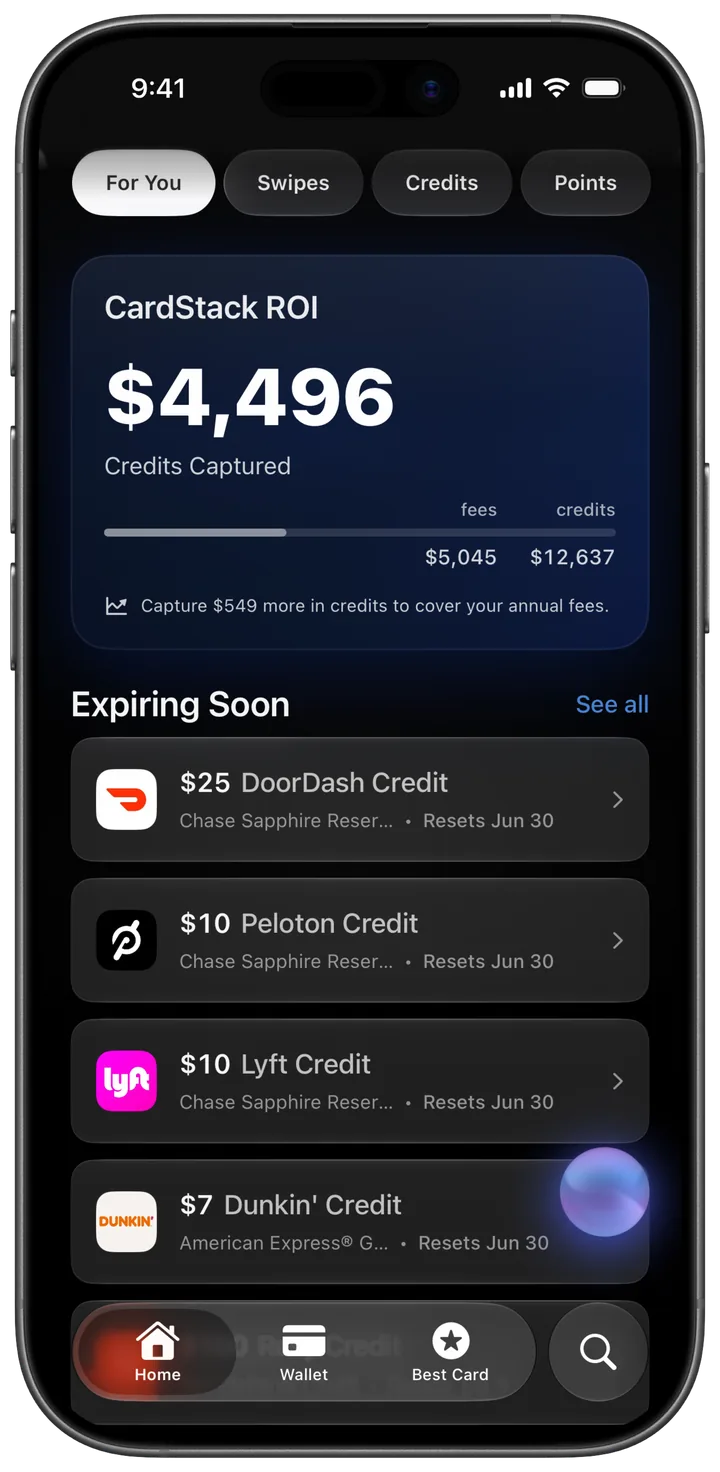
Credits that track themselves. Connect your bank through Plaid (read-only; CardStack never sees your login) and your credits update automatically. Use your Uber cash? Marked as redeemed. Pay for Walmart+ with your Platinum? Done. No spreadsheet to update, no checklist to keep honest.
Reminders that actually prevent missed money. Push notifications before credits expire, before your annual fee posts, and when new credits become available. I got a notification 3 days before my Amex airline credit was about to reset. Booked a bag fee. $200 saved in 30 seconds. Without that nudge, I would’ve lost it again.
Wrong card detection. CardStack analyzes every transaction and flags when you used a card that earned less than another card in your wallet. Last month it caught that I used my Sapphire Reserve at Whole Foods instead of my Gold card. That’s the difference between 1x and 4x on a $180 grocery run. Over a year, those mistakes add up to real money.
Annual fee math on your actual spending. Not a generic blog post saying “the Platinum is worth it if you travel a lot.” Actual math. Your credits used divided by your annual fee. CardStack told me my Chase Sapphire Reserve was covering its $795 fee with room to spare, but my second premium card wasn’t. I downgraded it and saved $700/year.
Best card, everywhere. Search by category (dining, groceries, travel, gas) or by your location, and CardStack ranks your cards by actual return. The ranking comes from the cards you hold, not from a blog post written for everyone.
Points in one place. All your balances across Amex MR, Chase UR, Capital One Miles, airline miles, and hotel points in one dashboard with dollar valuations. No more logging into six apps to figure out what you have.
Stack, an AI agent that knows your wallet. Instead of navigating menus, you ask Stack a question. “How much of my Platinum credits have I used?” “What’s my best card for dining tonight?” “Remind me to use my Resy credit this weekend.” Stack can mark credits used, set reminders, update balances, find flights with points vs. cash, and flag credits about to expire. Stack is early and some requests still stump it, but it already saves me from digging through three screens to answer one question. (See what Stack can do →)
The Price Difference Nobody Talks About
This is the part that gets me.
MaxRewards Gold, the tier you need for benefits tracking and the features that actually matter, starts at $9/month. That’s $108/year minimum, and it scales higher based on how many cards you add. Their Platinum tier is $20+/month ($240+/year).
CardStack+ is $69.99/year.
For less than half the price, you get automatic credit tracking, wrong card detection, annual fee ROI, spending analysis, the best-card engine, widgets, browser extensions, and Stack.
I’m not saying MaxRewards is a rip-off. Their offer activation is legitimately good and if that’s the main thing you need, the Gold tier pays for itself. But if you’re paying $108+ to track benefits and credits, you should know there’s an option that does it better for less.
Side-by-Side Comparison
| Feature | MaxRewards | CardStack | Edge |
|---|---|---|---|
| FeatureOffer auto-activation | MaxRewardsAmex, Chase, BofA, Citi, Discover | CardStackAmex, Chase (via extension) | EdgeMaxRewards |
| FeatureBonus category auto-activation | MaxRewardsYes (Chase Freedom, Discover, etc.) | CardStackNo | EdgeMaxRewards |
| FeatureCredit tracking | MaxRewardsYes (Gold tier) | CardStackYes, automatic via Plaid | EdgeCardStack |
| FeatureAuto-mark credits as used | MaxRewardsNo | CardStackYes | EdgeCardStack |
| FeatureCredit expiration reminders | MaxRewardsYes (Gold) | CardStackYes, push notifications | EdgeCardStack |
| FeatureAnnual fee ROI on real spend | MaxRewardsCard Value (Gold) | CardStackYes, effective annual fee + verdict | EdgeCardStack |
| FeatureWrong card detection | MaxRewardsNo | CardStackYes | EdgeCardStack |
| FeatureSpending analysis / missed earnings | MaxRewardsLimited | CardStackYes, per-transaction breakdown | EdgeCardStack |
| FeatureKeep / downgrade / cancel advice | MaxRewardsCard Value (Gold) | CardStackYes, with dollar reasoning | EdgeCardStack |
| FeatureBest card by category & location | MaxRewardsYes | CardStackYes | EdgeTie |
| FeaturePoints tracker (dollar values) | MaxRewardsBalances only | CardStackYes, across all programs | EdgeCardStack |
| FeatureAI agent | MaxRewardsNo | CardStackYes (Stack) | EdgeCardStack |
| FeatureHome-screen widgets | MaxRewardsYes | CardStackYes | EdgeTie |
| FeatureBrowser extension | MaxRewardsChrome (beta) | CardStackSafari + Chrome | EdgeCardStack |
| FeaturePlatforms | MaxRewardsiOS + Android | CardStackiOS + Android | EdgeTie |
| FeatureCredit scores / bills | MaxRewardsYes | CardStackNo | EdgeMaxRewards |
| FeaturePrice (for benefits tracking) | MaxRewards$108+/year (Gold) | CardStack$69.99/year | EdgeCardStack |
MaxRewards wins on two things: more issuers for offer activation and bonus category auto-activation. If those are your priorities, use MaxRewards.
On credit tracking, fee ROI, and price, CardStack comes out ahead.
Who Should Use MaxRewards
If your main goal is auto-activating offers across every issuer, MaxRewards is the better tool for that today. They support more issuers for background activation (BofA, Citi, Discover) and they handle rotating bonus categories automatically.
Both CardStack and MaxRewards are available on iOS and Android.
And if you want credit scores, bill tracking, and autopay reminders in the same app as your rewards tracking, MaxRewards puts all of that together.
Who Should Use CardStack
If you have premium cards, you’re paying hundreds or thousands in annual fees, and the question that matters is whether you’re capturing the value you already pay for.
CardStack answers it. It tracks your credits automatically, nudges you before money expires, flags purchases you put on the wrong card, and does the annual fee math on your real spending, without you checking a dashboard to stay on top of it.
All for less than half the price of MaxRewards Gold.
I built this because I was tired of paying $1,200 in fees and only getting half the value back. Now I capture almost all of it, and I barely think about it.
What People Are Saying
“Loving the app CardStack, which lets me keep track of all my key credit cards and benefits / offers so I don’t forget to use any of them. I was doing this with AI tracking and a spreadsheet, but CardStack has Plaid connection so it auto-syncs everything nicely. (I have no affiliation with this app—just a very happy subscriber!)” — @jwang815 on Threads
“Within 1 minute of using the app I discovered I had enough funds for YouTube premium and free global traveler / tsa pre check with Amex Plat, this app is already goated!!!” — @imjonlacey on Threads
FAQ
Is MaxRewards worth it in 2026? It depends on what you need. MaxRewards Gold ($108+/year) is worth it if offer auto-activation across multiple issuers is your top priority. If you care more about credit tracking, annual fee ROI, and spending optimization, CardStack does those better at $69.99/year.
Is MaxRewards safe? MaxRewards connects to your issuer accounts to auto-activate offers. Some people aren’t comfortable with that. CardStack uses Plaid for read-only transaction access (the same infrastructure behind Venmo and Coinbase) and a browser extension for offers, so you never share bank logins with the app.
Can I use both MaxRewards and CardStack? Yes. Some people use MaxRewards for offer activation on issuers CardStack doesn’t cover (BofA, Citi, Discover) and CardStack for credit tracking, spending analysis, and Stack. They don’t conflict.
Does CardStack work on Android? Yes. CardStack is available on Google Play, as well as the App Store.
How much does CardStack cost vs MaxRewards? MaxRewards: Free (Bronze), $9+/month (Gold), $20+/month (Platinum). CardStack: Free trial, then $69.99/year. Lifetime access is also available.
Related Articles
Maximize Your Credit Card Rewards
CardStack automatically tracks your benefits, activates your Amex and Chase offers, and shows you the best card at checkout so you can save more money and earn more points.


CardStack Insiders
Newsletter
Card news, standout deals, and product updates—straight to your inbox.
By signing up, you agree to our Terms and Privacy Policy. Unsubscribe anytime.
Read Next
Related articles